A damp patch on the wall of an old house is rarely cured by sealing the wall. Find where the water is coming from, take it away, and let the wall dry itself. That is my judgement, and the council guidance I opened for this piece points the same way. Below are four ideas I would unlearn before ringing anyone.
"Damp means rising damp"
It is the phrase everyone reaches for, and it sends people straight to a specialist firm. Brighton & Hove City Council begins somewhere else: "In the first instance, the cause of the damp should be identified, and as far as possible removed" (Brighton & Hove City Council).
West Suffolk Council's conservation leaflet lists the usual suspects, and none of them is a mystery rising through the floor: missing, leaking or blocked guttering and down-pipes, and high ground levels where soil or paving has built up against the wall (West Suffolk Council). It advises checking the roof, chimneys, guttering, render, brickwork and joinery, and making sure external paths slope away from the walls.
Taken together, that gives a short list of what I would check first, in this order:
- gutters and down-pipes
- the roof and the chimneys
- paths, beds and ground levels against the wall
- render and brickwork
- joinery
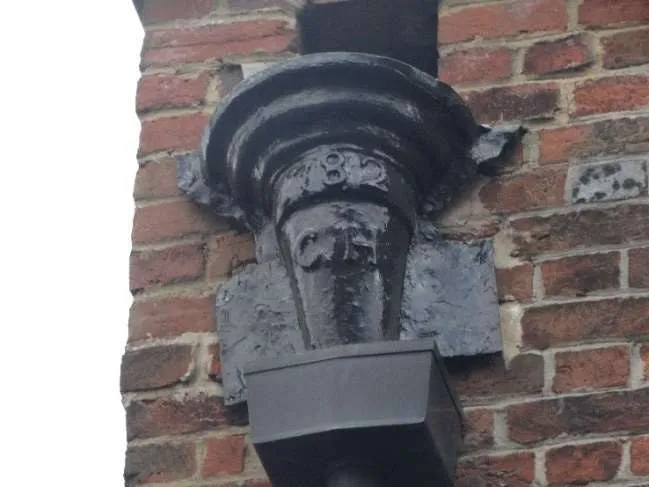 A cast-iron rainwater hopper on the former schoolrooms at Bluecoats, Hertford. Where this kind of fitting fails, the wall below takes the water.
I wrote about the rules for repairing gutters without consent earlier this month, and it is where I would begin on a wet wall.
"The wall must be sealed"
Modern building teaches us that a wall is a barrier. An old solid wall works the other way: it is a sponge. West Suffolk's leaflet describes how older walls absorb moisture in damp conditions and release it through evaporation on dry days. Its warning follows from that: cement render and waterproof coatings can stop the structure breathing and lead to a build-up of moisture within the walls.
A wall that is damp is telling you something; the job is to listen before anyone sprays anything.
This is also why I am careful about hard cement pointing, which I covered in repointing a listed building. The mortar I would choose is the one that lets the wall dry through it, and I judge that by looking at what is already there.
"A damp-proofing firm's quote is a diagnosis"
A quotation is a price for a treatment. A diagnosis is a different thing, and I would pay for the diagnosis first. Brighton & Hove advises getting input from an independent, qualified surveyor and not relying only on a damp-proofing company's quote. It is blunt about chemical treatments: they "are not always effective in historic buildings", it calls them "rarely appropriate" and "irreversible", and it warns that they can trap damp, increase decay or just move the problem elsewhere. West Suffolk says a chemically injected damp-proof course "seldom works" in a historic building.
The same Brighton & Hove page says standard tanking systems "do not allow the building to breathe". It adds that dry lining "may be more appropriate in historic buildings", and that it "should be ventilated". Those are one council's words, not a rule, so ask your own.
"A new floor and a warm room will sort it"
Two quiet changes are worth thinking twice about. The first is replacing a breathable floor with concrete: West Suffolk warns that this can push ground moisture into the walls instead. The second is condensation. Its leaflet suggests opening windows and heating rooms to deal with condensation from poor ventilation. In my judgement, a house that has just been draught-proofed deserves a watchful winter. I covered that choice in what I would do about draughty windows before winter. If a window that used to leak now streams with water, tell whoever advises you.
Does the work need consent?
Possibly, and the treatments are the part most likely to. Brighton & Hove says "Damp treatment in listed buildings is likely to require consent". Section 7 of the 1990 Act forbids works for the "alteration or extension" of a listed building "in any manner which would affect its character" unless they are authorised (legislation.gov.uk). GOV.UK's guidance says the listing covers the whole building, "internal and external", and encourages owners to discuss the matter with the local planning authority before applying (GOV.UK).
Clearing a gutter or lowering a flower bed is housekeeping. Injecting walls, tanking, stripping plaster or relining a floor is the kind of work I would never start without a call to the conservation officer. Whether your particular works need consent depends on your list entry, your building and your council, and I cannot tell that from here.
What stripped plaster can teach you
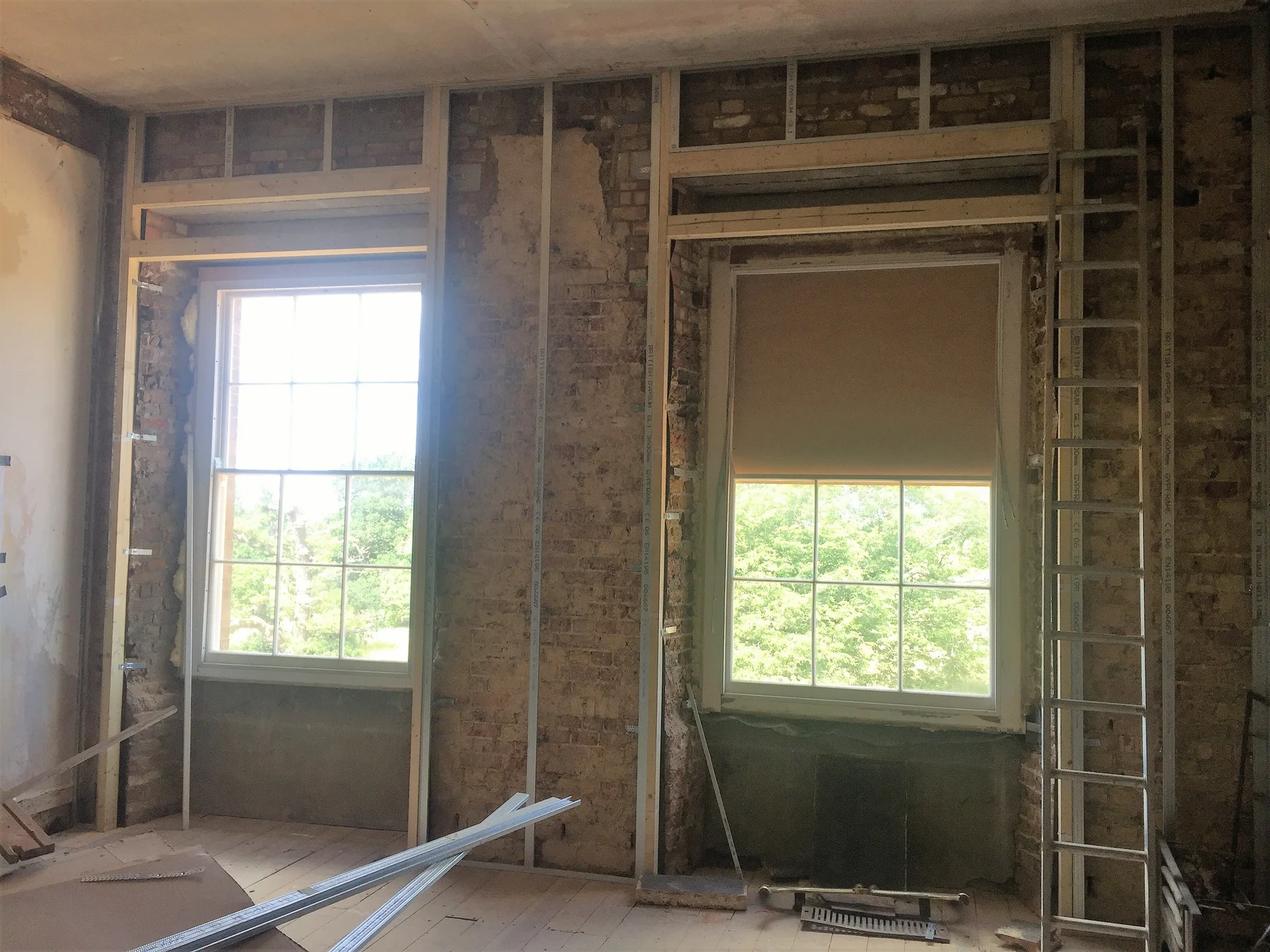
The photograph at the top shows a room at Sacombe House during works, with plaster stripped back from the window openings and the bare brick and timber framing visible. When the finishes come off, a wall tells its own story: where it has been wet, and how it has been patched. I like to see that before anyone proposes anything, which is why a survey is worth doing before a specification. If you would like a first look at how I work, what a heritage architect looks for on the first visit is the place to start, and we work across Hertfordshire, among other places: see the Hertfordshire page.
I think the happiest old houses are the ones that are allowed to dry.
Speak to Giles about your building: book a conversation, get in touch, call +44 (0)7737 745211, or send a WhatsApp voice note.
Giles Paul Shorter — RIBA Chartered Architect · ARB Registered · RIBA Conservation Registrant · 17+ years specialising in listed and historic buildings.
- Planning (Listed Buildings and Conservation Areas) Act 1990, section 7 — Restriction on works affecting listed buildings ↗ (accessed 2026-10-12)
- GOV.UK — Planning practice guidance: Conserving and enhancing the historic environment ↗ (accessed 2026-10-12)
- Brighton & Hove City Council — Damp treatment (heritage) ↗ (accessed 2026-10-12)
- West Suffolk Council — Conservation leaflet: damp in historic buildings ↗ (accessed 2026-10-12)