
Picture a Sunday evening in late October. The curtains move when nobody has opened a window, and the owner of a listed house is reaching for the phone to price new double-glazed units. If it were my house, I would put the phone down. Mend and seal what is there first, and add secondary glazing behind it only if the rooms still need more. Ask your council before you start.
That order is my own judgement, not a rule. This post sets out the steps I would take, and where the councils I have read disagree with each other.
Step 1: Find where the draught actually comes from
Windows often take the blame for draughts that start elsewhere. On a cold, windy evening I would go round with a candle or a strip of tissue, and I would also look at:
- the gap between frame and wall, where old mastic or lime has cracked
- the sash cords and meeting rail, which let air through when they have worn
- shutters, boxings and window seats, which can be loose
- the floor edge and the chimney, which are often the real culprits
I would write down which windows are worst before touching any of them. A list makes the next steps cheaper, because the repairs go where they are needed.
Step 2: Repair before replacing
Windows are part of the character of a listed building, so the legal question is about what happens to them. Section 7 of the 1990 Act says no one may carry out works "for the demolition of a listed building or for its alteration or extension in any manner which would affect its character as a building of special architectural or historic interest" unless they are authorised (legislation.gov.uk). GOV.UK's planning practice guidance adds that the listing covers the whole building, inside and out (GOV.UK).
Canterbury City Council puts the everyday line plainly: consent is needed for work that "changes the character of the building, but not for repairs and general maintenance" (Canterbury City Council). Easing a stuck sash, renewing a cord or re-puttying a pane is repair. Swapping the whole window is not.
The same council is blunt about the alternatives. "Double glazing is not normally allowed," it says, and plastic (uPVC) and aluminium windows "must not be used in historic buildings". It points owners instead to draught-proofing and secondary glazing behind the original windows. That is one council's policy, and yours may word it differently.
Step 3: Seal the gaps
Draught-proofing is the cheapest improvement, and it leaves the window as it was. Done well, it is discreet: a brush or compressible strip in the joint, tight to the frame, with nothing showing from outside or in. Done badly, it jams a sash or hides a moulding.
I would also keep the ventilation a damp old house needs. A building that has breathed for two hundred years does not take kindly to being wrapped. Seal the draughts, not the whole house.
Step 4: Think about secondary glazing, and ask about consent
If the rooms are still cold or noisy, a second pane inside the original window is the option I would look at first. In my view it is the gentlest upgrade, because it leaves the original window in place.
Whether it needs consent depends on where you live:
| Council | What it says | What I take from it |
|---|---|---|
| Bath & North East Somerset | "Listed Building Consent is normally required for secondary glazing." It adds that "in many circumstances magnetic strip secondary glazing is likely to be consented." | Ask first, and expect the lighter systems to be easier |
| Canterbury | Names draught-proofing and secondary glazing behind the original windows as the route to better insulation | The council steers you to it, but check what it wants to see |
(Bath & North East Somerset Council; Canterbury City Council)
Bath and North East Somerset also describes draughtproofing as "a complementary measure which can be used in conjunction with secondary glazing". Whether to do both, and in what order, is a question for your own conservation officer. Put it in writing before anything is ordered.
What the windows taught us at Bluecoats
At Bluecoats in Hertford, the survey recorded an eighteenth-century casement with later cast-iron glazing bars among the features to be kept (Bluecoats, Hertford). In my judgement, that is the sort of window where replacement would erase evidence and careful repair keeps it.
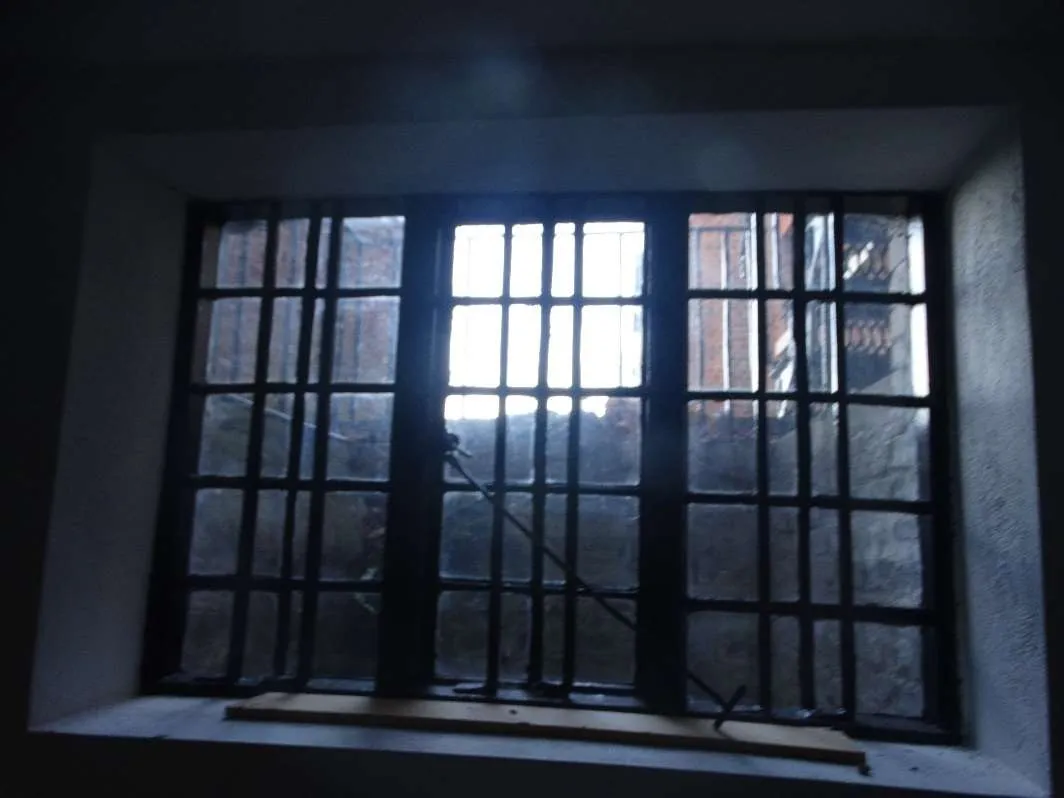 An eighteenth-century casement with later cast-iron glazing bars, Bluecoats, Hertford.
What this means for you
Photograph each window, inside and out, before anyone touches it. Repair what is there. Seal the gaps. Ask your council about secondary glazing in writing, and wait for the answer. Nobody can promise you a consent in advance, but a short email in October is cheaper than a wrong turn in January.
When do you need a professional?
When the frames are rotten rather than merely loose. When the windows are early, such as casements or crown glass. When the house is listed at a high grade. When you cannot tell whether a window is original. I wrote about the first walk round a building in what a heritage architect looks for on the first visit, and about the other end of the autumn jobs in gutters and repointing. Windows are the next job on the same walk. You can see where we work on the Hertfordshire page.
An old window that rattles is usually a window that can be saved. I find that a hopeful thing to say in the first cold week of the year.
Speak to Giles about your building: book a conversation, get in touch, call +44 (0)7737 745211, or send a WhatsApp voice note.
Photo: Joshua Hoehne on Unsplash.
Giles Paul Shorter — RIBA Chartered Architect · ARB Registered · RIBA Conservation Registrant · 17+ years specialising in listed and historic buildings.
- Planning (Listed Buildings and Conservation Areas) Act 1990, section 7 — Restriction on works affecting listed buildings ↗ (accessed 2026-10-08)
- GOV.UK — Planning practice guidance: Conserving and enhancing the historic environment ↗ (accessed 2026-10-08)
- Canterbury City Council — Guidance on common work to listed buildings ↗ (accessed 2026-10-08)
- Bath & North East Somerset Council — Energy efficiency, retrofitting and sustainable construction: secondary glazing ↗ (accessed 2026-10-08)