
Dear owner of a cold sitting room,
You are about to light the first fire of the winter, and you have asked what a heritage architect would check first. Have the chimney swept, by someone who will tell you what they find. It is the cheapest check there is. Anything beyond lighting a fire you already have, such as fitting a stove or a new flue liner, is a different kind of job, with different rules, and I come to it further down.
The sweep comes before the match
One English fire and rescue service puts it simply: "You should have your chimney swept before lighting the first fire of the winter", and it adds that appliances which have not been used for a while should be given a safety check (fire and rescue service advice). Its suggested frequencies depend on the fuel:
| Fuel | How often the service suggests sweeping |
|---|---|
| Smokeless fuel | Once a year |
| Coal | Twice a year |
| Wood | Four times a year, when in use |
The same page suggests that you consider fitting a carbon monoxide detector. In an old house I would not treat that as optional.
An old flue can fail quietly. Brighton & Hove City Council says that if a chimney "has not been used for some time it's essential to have it inspected and swept before using solid fuels" (Brighton & Hove City Council). A Hertfordshire building control leaflet describes what an unlined chimney can do: it can "leak products of combustion and tars through the chimney walls", and the flue surface and mortar joints can be "eaten away by corrosive condensates and soot deposits" (Hertfordshire Building Control Technical Forum). That leaflet dates from 2011, so check that its detail still holds with your own building control team.
Why the sweep is also a conservation job
A sweep sees what you cannot from the garden. In my judgement, what a good one reports is the best early warning an owner gets:
- loose or missing brick and mortar inside the flue
- birds' nests or fallen debris
- soot staining on a chimney breast, which may mean smoke is escaping into the wall
- a cracked or missing hearth, or a fireplace opening that has been altered at some point
I would photograph all of it. Chimney breasts, grates, surrounds and hearths are often part of what makes a room significant, and I wrote about how we weigh them in which parts of a listed interior can change. Repair and sweeping are maintenance. Altering a fireplace is not.
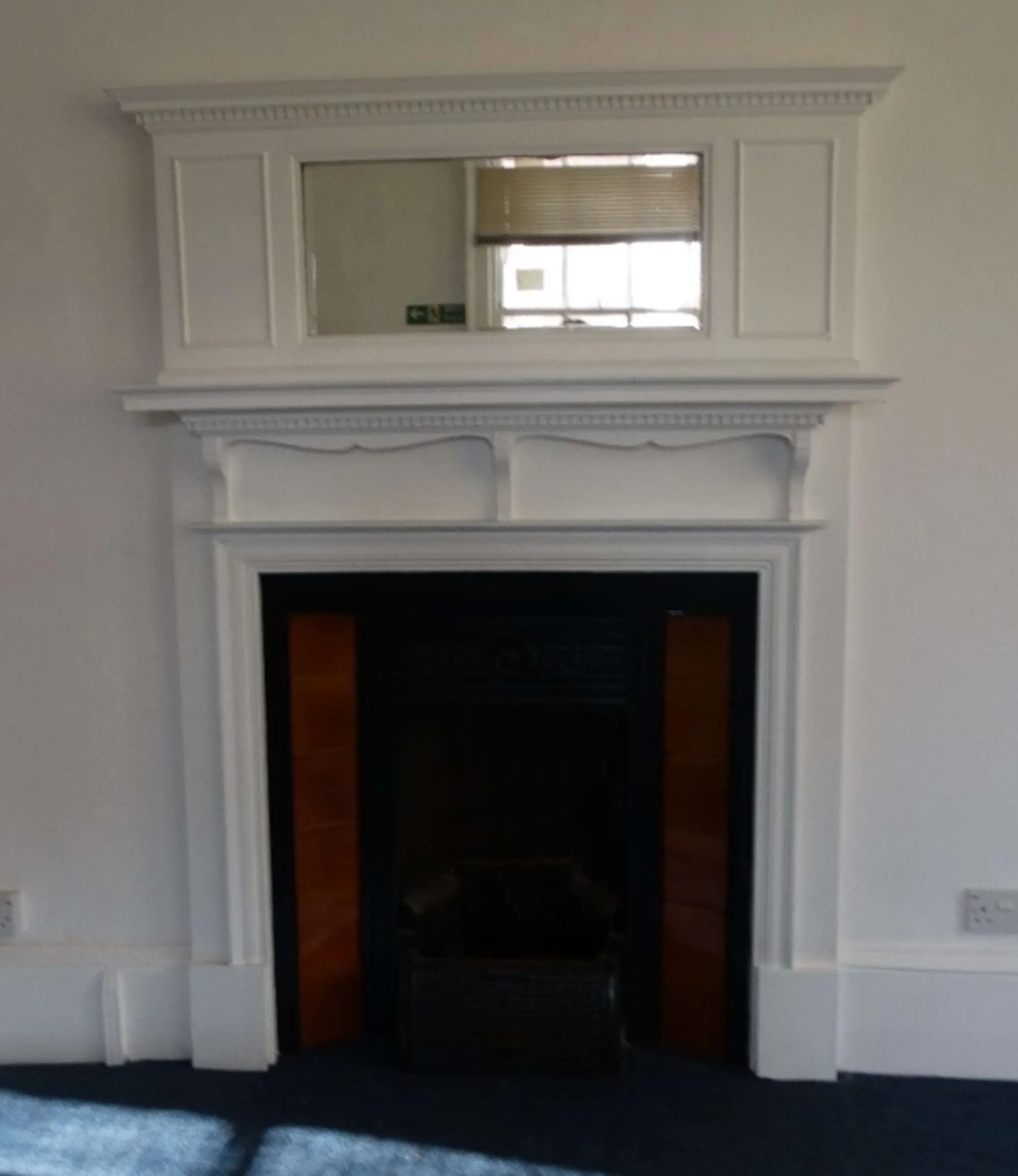 An Edwardian fireplace with a mirrored overmantel, one of the original features kept in use at Bluecoats, Hertford.
The survey at Bluecoats recorded marble and Edwardian fireplaces among the features to be kept (Bluecoats, Hertford). A fireplace of that quality is why I would never let anyone hack out an old surround to make room for something new.
Lighting the fire you have, and fitting something new
These are two separate questions, and owners often run them together.
Lighting an existing fire in a sound, swept chimney is ordinary use. I would not expect it to need consent, but if you are unsure, ask your council.
Fitting a stove, or relining or installing a flue, is something else. The Hertfordshire leaflet says that installing wood burning and multi-fuel stoves "is work that is controlled under the Building Regulations", as is "the re lining or installation of flues and chimneys". It explains that a registered installer working under a competent person scheme can self-certify, and otherwise an application to building control is needed. Brighton & Hove adds that solid fuel burners must be "fitted in accordance with Part J of the Building Regulations".
That is Building Regulations. Listed building consent is separate, and a listed building adds a second question. Section 7 of the 1990 Act forbids works for the "alteration or extension" of a listed building "which would affect its character" unless they are authorised (legislation.gov.uk). GOV.UK's guidance says the listing covers the whole building, "internal and external", and that where there is doubt, owners should "discuss the matter with the local planning authority" before applying (GOV.UK).
I cannot tell you from here whether your stove or liner would need consent. That depends on your list entry, your building and your council. What I can show you is what one council's records look like. In a 2022 decision, Copeland Borough Council gave listed building consent for a wood burning stove with an external flue on a Grade II house. Its conservation officer judged the harm to be "towards the negligible end of the scale", and the application had been supported by a heritage statement and a structural report explaining why the existing chimney stack was not practical to reuse (Copeland Borough Council). That was one house and one council's judgement. It does not mean yours would be treated the same way.
What I would do this week
- Book a sweep, and ask for a short written note of what was found.
- Photograph the fireplace, hearth and chimney breast as they are.
- Fit a carbon monoxide alarm if you have not got one.
- If you want a stove or a liner, speak to your council before anyone orders one, and ask both its conservation officer and its building control team.
When a sweep is not enough
When the sweep finds damage to the flue or the masonry. When a chimney has stood unused for years. When you want a stove in a room with a fine original fireplace. Or when you cannot tell whether a fireplace is original.
This is the next job on the same autumn walk that took us past the windows, the gutters and the repointing. If you want the whole house read in one go, I described that first visit in what a heritage architect looks for on the first visit. We work across Hertfordshire, among other places: see the Hertfordshire page.
I find a swept chimney and a lit fire a good sign of a house being looked after. Let it draw well before you worry about anything else.
Speak to Giles about your building: book a conversation, get in touch, call +44 (0)7737 745211, or send a WhatsApp voice note.
Photo: Xin on Unsplash.
Giles Paul Shorter — RIBA Chartered Architect · ARB Registered · RIBA Conservation Registrant · 17+ years specialising in listed and historic buildings.
- Planning (Listed Buildings and Conservation Areas) Act 1990, section 7 — Restriction on works affecting listed buildings ↗ (accessed 2026-10-08)
- GOV.UK — Planning practice guidance: Conserving and enhancing the historic environment ↗ (accessed 2026-10-08)
- Fire and rescue service advice — Chimneys and open fires ↗ (accessed 2026-10-08)
- Brighton & Hove City Council — More information about solid fuels ↗ (accessed 2026-10-08)
- Hertfordshire Building Control Technical Forum — Technical Guidance Leaflet 16: Installing Solid Fuel Stoves (2011) ↗ (accessed 2026-10-08)
- Copeland Borough Council — Delegated planning decision 4/22/2372/0L1 (listed building consent for a stove and flue, 2022) ↗ (accessed 2026-10-08)