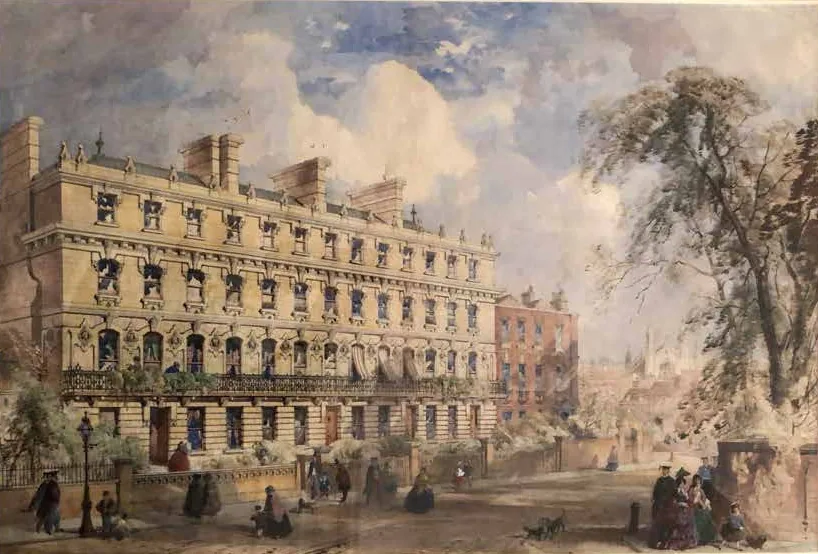
After a gale, the most useful thing an owner can do is describe the damage in the right words. "Something is wrong up by the chimney" gets a shrug. "The flashing has lifted where the stack meets the slope" gets a roofer, and a conservation officer, to the right place. Here are five words that do that work, and a note on where consent may come in for each.
New to this? Start with Listed building questions answered
Why words matter on a listed roof
The listing is not only the bricks and the slates. Section 1 of the 1990 Act says that "any object or structure fixed to the building" is treated as part of it. I read that as covering the pots on a chimney and the lead dressed around it, though I would not argue the point for your house without seeing the list entry.
And the test for works is the one I have quoted before: section 7 refers to works "for its alteration or extension in any manner which would affect its character". A job described precisely is far easier to place on the right side of that line.
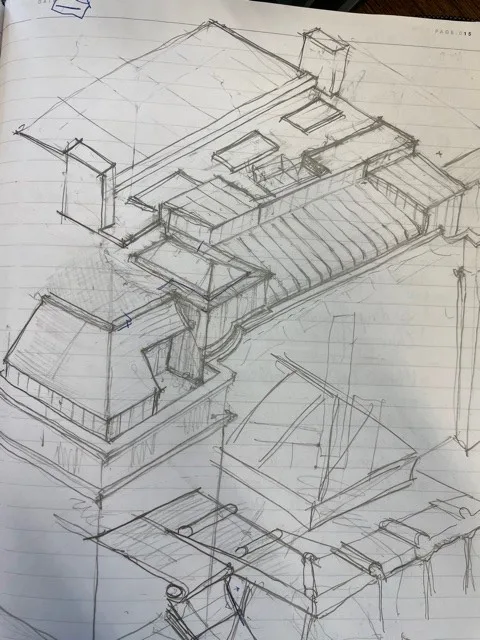 A pencil study of roof planes and chimney stacks from the Sacombe House project collection. Every word below is a piece of a drawing like this one.
Stack
The stack is the brick or stone column that carries the flues up through the roof. It is the tallest, most exposed part of the house, so it takes the worst of a gale.
From the garden, look for a lean, for brickwork that has opened up, and for fallen fragments on the ground. Do not climb up to look closer.
Bradford Council's advice for its listed buildings in Saltaire says that "Listed Building Consent may be required to replace chimney pots or rebuild the chimney stack". That is one authority's view of its own area, and yours may differ. It is also why I would photograph a damaged stack and ring the conservation officer before anyone mentions the word rebuild.
Pot
The pot is the clay pipe on top of the stack. Pots are small, so owners treat them as disposable. On an old house they are often part of the look of the roofline.
If one has fallen, keep every piece. The same Bradford page asks for replacements to be "reclaimed chimney pots or authentic replica pots", which tells you how seriously one council takes the match. Pots go to the council's attention for the same reason slates do: a replacement can change what the roof looks like from the road.
Flaunching
The flaunching is the mortar bed that holds the pot in place and sheds rain off the top of the stack. It is the quiet part of the chimney, and when it cracks, water gets into the flue and the brickwork below.
I cannot give you a consent rule for flaunching from a source I have opened, so I will not invent one. What I can say is that it is mortar, and I wrote about the mortar question in my piece on repointing a listed building without consent: match what is there, photograph it first, and ask when in doubt.
Flashing
The flashing is the strip of lead, usually, dressed around the foot of the stack where it meets the roof. It is the joint that keeps water out, and a gale can lift its edge.
Here the official wording is encouraging. Bradford Council says: "Listed Building Consent is not required provided repairs are undertaken with lead to match the existing flashings." The condition is the important part. Change the metal, the method or the look, and the sentence no longer applies.
Like for like
This one is not a roof part but a test. Like for like means the same material, the same size and the same way of fixing, so that the repair leaves the roof looking and behaving as it did.
GOV.UK's planning practice guidance says that the listing "covers the entire building, internal and external", that works affecting special character without consent are a criminal offence, and that where it is unclear whether consent is needed you should "discuss the matter with the local planning authority" before you apply. So the safest like for like is one your council has seen on paper.
A table to keep by the telephone
| What you see from the ground | The word to use | What I would do first |
|---|---|---|
| The stack leans or has opened up | Stack | Photograph it, keep people away from below it, and ring the council |
| A pot is missing or cracked | Pot | Keep the pieces, and ask before ordering a new one |
| A crack or gap at the top of the stack | Flaunching | Photograph it and describe it as mortar |
| Lead lifted where the stack meets the slope | Flashing | Photograph it, and ask for a repair in matching lead |
| A roofer's quote with no detail | Like for like | Ask for it in writing, item by item |
What I would say on the telephone
Something like this: "After the gale, the flashing on the north side of the main stack has lifted, and one pot has come down. I have photographs, and I have kept the pot. What would you like to see from us?" It names the part, says what you have done and asks the council a question it can answer.
A drawing helps more than most owners expect. At Cintra House, the project page records that the stacks had been rebuilt as "poor approximations of the originals", and that a watercolour of about 1890 became the evidence for restoring them. The painting above is that kind of evidence in the best sense: it shows what the roofline was meant to be.
This is the next job after the slipped slate in my piece on the morning after a gale, and it follows from the sweep I described in the note on lighting the first fire. The questions owners ask me most often are on the questions answered page, linked at the top.
A last word
Roofs are read from the edges: the stack, the flashing, the line where one material meets another. A few exact words and a few photographs will take you further than any amount of worry. I would rather you learn the words on a dry day.
Speak to Giles if you would like help working out what a storm has done to your listed roof: book a conversation, get in touch, call +44 (0)7737 745211, or send a WhatsApp voice note.
Giles Paul Shorter — ARB registered · RIBA member · on the RIBA Conservation Register · 17+ years specialising in listed and historic buildings.
- Planning (Listed Buildings and Conservation Areas) Act 1990, section 1 — Listing of buildings of special architectural or historic interest ↗ (accessed 2026-10-21)
- Planning (Listed Buildings and Conservation Areas) Act 1990, section 7 — Restriction on works affecting listed buildings ↗ (accessed 2026-10-21)
- GOV.UK — Planning practice guidance: Conserving and enhancing the historic environment ↗ (accessed 2026-10-21)
- City of Bradford Metropolitan District Council — Pre-application listed building advice for Saltaire ↗ (accessed 2026-10-21)
Text © 2026 SOANE Architects Ltd. You’re welcome to quote a short extract with a credit and a link back. Photographs belong to their photographers and are credited beneath each image.