
If a stain has appeared on a ceiling and the gutters you can see are clear, the water is probably going somewhere you have not looked: a valley, a parapet or a gutter hidden behind the roof edge. Those are the places I would climb to, or send someone up to, before anything else.
New to this? Start with Listed building questions answered
Last week I wrote about small holes in the roof timbers and why damp matters more than beetles. This week I want to follow the water itself, because it is the water that decides how the timbers fare.
Start at the ridge and follow one drop
Picture a single raindrop landing on the ridge of an old house, and walk with it.
- It runs down the slope of slate or tile, as it was designed to.
- It meets a valley, where two slopes join, and where the water of two roofs arrives at once in a lead or metal channel.
- Or it meets a parapet, a low wall at the edge of the roof, with a gutter lined behind it that you cannot see from the ground.
- It crosses a flashing, the strip of metal that seals the joint where roof meets chimney or wall. I covered those words in the roof glossary.
- It reaches the gutter and a downpipe, if all has gone well, and leaves.
Most owners check the last step, because it is the one they can see from the garden. My own judgement, not a rule, is that trouble is easier to miss at steps two to four, because they are out of sight.
A gutter you can see from the garden is the easy one to look after.
The places the water gets stuck
Two councils I opened this morning give plain advice on exactly these spots. Both guides are from 2010, so read them as a starting point, and ask your own council what it says today.
| Where | What can go wrong | What one council says |
|---|---|---|
| Valley gutter | Leaves and silt collect; lead cracks or wears | Bedford Borough Council: "pay close attention to flashings and valley gutters as water ingress through these areas can lead to timber decay requiring substantial repair works" |
| Parapet gutter | The channel is hidden, so blockages go unseen until water comes through the ceiling | Warwick District Council wants front-to-back discharge systems from parapet gutters kept, and says they "can be improved by using a pipe system with access plates to avoid flooding in the roof" |
| Flashings | A gap lets water behind the lead | Bedford: close attention, as above |
| Gullies and downpipes | Blocked, so the water backs up | Bedford: clear them "at least every six months and particularly after the autumn fall of leaves" |
Bedford calls that clearing "one of the most important maintenance operations", and adds that if it is neglected it "will soon lead to major problems". I agree with the order of importance, and it is cheap compared with replacing a rotted wall plate.
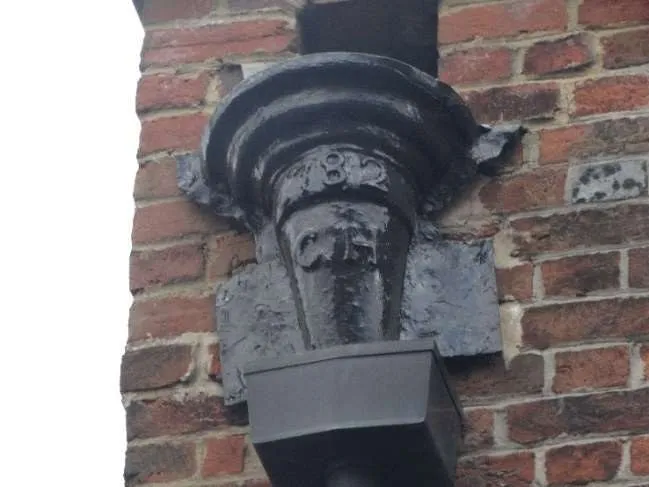 A cast-iron hopper at the top of a downpipe, as shown on the Bluecoats House case study. A hopper sits at the top of a downpipe, where the water from a gutter is gathered.
A fortnight of small jobs
The days are short and the leaves are down, so this is a good fortnight for it. None of these steps touches historic fabric:
- Look from the ground with binoculars along the roof edge and into the valleys. Note any plants, leaf drifts, or a gap where lead has lifted.
- Look inside on the next wet day. A new stain, or an old one that has darkened, tells you which part of the roof is leaking and when.
- Clear what you can reach safely. Leaves and silt out of gullies and downpipes, by hand, from the ground or a safe ladder.
- Leave the high work to someone who works at height. Valleys and parapet gutters usually cannot be reached safely from a garden ladder, and a fall costs more than any roof.
- Take dated photographs before and after, for your own record and for your council if you need to call them.
Snow is a winter task too. Bedford recommends "clearing snow from valley and parapet gutters to prevent it building up above the level of flashings", because meltwater then has somewhere to go that it should not.
The quick fixes I would resist
When water is coming in, a roll of bitumen tape or a tin of roof sealant looks like a mercy. Bedford's guide is blunt: repairing leadwork "with bitumen coated fabrics or tapes is not recommended as they conceal later-developing faults and inhibit carrying out of permanent repairs", and it tells owners of listed buildings that spray-on roof treatments and bitumen repairs of leadwork "would be unacceptable".
Warwick's guide adds a principle I would hold to: "Lead roofs should always be replaced with lead." Whatever you do, avoid changing a roof's metal to a different one without asking, because the look and the life of the roof change with it.
When the council needs to hear from you
Section 7 of the 1990 Act says that no one may carry out works "for the demolition of a listed building or for its alteration or extension in any manner which would affect its character as a building of special architectural or historic interest" unless they are authorised (section 7 of the 1990 Act).
Clearing leaves is not that. A patch of like-for-like lead may not be either, but a new gutter layout, a different metal or a rebuilt parapet could be, and the answer depends on your building and your council. Bedford's guide also says a total re-roofing of a listed building "will usually require listed building consent".
GOV.UK's planning practice guidance encourages owners who have any doubt to talk to the local planning authority before they begin. I would ring them with your photographs in front of you, and before the roofer's van arrives, not after.
A word on the next storm
Water on an old roof is a patient thing and it only needs one open joint. A morning spent on the valleys and the hidden gutters is, in my judgement, one of the better uses of an autumn weekend, and there is a gentle comfort in knowing where your roof sends its rain.
If you would like a second pair of eyes on a roof you cannot reach, I would be glad to help. For the wider picture, my piece on whether gutters need consent is the related guide above, and the damp article explains what trapped water does once it is inside the wall.
Speak to Giles about a roof that worries you: book a conversation, get in touch, call +44 (0)7737 745211, or send a WhatsApp voice note.
Giles Paul Shorter — ARB registered · RIBA Chartered Member · on the RIBA Conservation Register · 17+ years specialising in listed and historic buildings.
- Planning (Listed Buildings and Conservation Areas) Act 1990, section 7 — Restriction on works affecting listed buildings ↗ (accessed 2026-11-02)
- GOV.UK — Planning practice guidance: Conserving and enhancing the historic environment ↗ (accessed 2026-11-02)
- Bedford Borough Council — Maintaining and repairing your historic building (conservation area maintenance guide, 2010) ↗ (accessed 2026-11-02)
- Warwick District Council — Historic Building Guidance: Roofs on listed buildings and in conservation areas (revised September 2010) ↗ (accessed 2026-11-02)
Text © 2026 SOANE Architects Ltd. You’re welcome to quote a short extract with a credit and a link back. Photographs belong to their photographers and are credited beneath each image.